Welcome to Official Website of Central Reserve Police Force
Welcome to Official Website of Central Reserve Police Force
In 1986, Haiti was under the command of the National Council of Government, led by Jean-Claude Duvalier. However, the country experienced a series of political instability in the following years, with four military coups taking place between 1986 and 1991. In 1991, the military government was replaced by a young priest, Jean-Bertrand Aristide, who took over as President after winning an election in November 1990. However, he was overthrown just seven months later by General Raoul Cédras.
US intervention
Aristide sought asylum in the United States, and US President Bill Clinton ordered US troops to prepare to enter Haiti to restore him to power. In October 1994, the US-led multinational force invaded Haiti, forcing the military junta to step down and allowing Aristide to return to power.
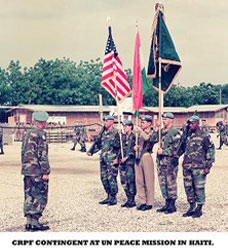
In March 1994, a contingent of 120 male personnel from the CRPF and Rapid Action Force (RAF) was deployed to Haiti as part of the US-led multinational force. This contingent, known as Company, worked in Haiti for various duties during the elections as part of the US Army's 504th Military Police Battalion (Dragon Fighters) under the UN Mission in Haiti (UNMIH).
The CRPF contingent played a vital role in ensuring the smooth conduct of the elections and the restoration of democracy in Haiti. The contingent was involved in a variety of duties, including:
The CRPF contingent was highly praised for its professionalism, dedication, and courage in performing its duties in Haiti. The contingent's contribution to the success of the US-led intervention and the restoration of democracy in Haiti is a testament to the CRPF's commitment to international peace and security.
Patrolling and guarding election polling stations and other sensitive locations
Providing security to election officials and voters
Preventing violence and intimidation
Maintaining law and order


 New Registration